Month: June 2020

What is SQL

SQL stands for : Structured Query Language.

Was designed to manage and maintain data in Relational Database Management Systems(RDBMS) which revolves around relational model and predicate logics.

Has three types of statements :

DDL (Data Definition Language)

Statements include :  Create, Alter, Drop

DML (Data Manipulation Language)

Statements include :  Select , Insert, Update, Truncate, Delete

DCL (Data Control Language)     

Statements include :  Grant, Revoke


What is a Database, Schema and Object

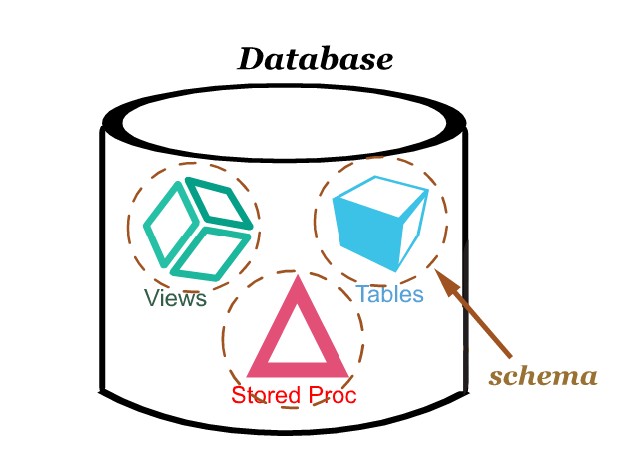
Consider a Database as a main box which contains inside it different boxes(schemas) and those boxes(schemas) contain different objects like (tables,views, stored procedures and functions etc)

  • When It is said that Objects are contained in the Schema ,so the best advantage of the Schema level is Security . You can assign the different users of a database , a certain amount of privileges/rights ;
  • For example:

– Allowing User A : To use only select statements .

– Allowing User B : To see Encrypted Stored Procedures allowing all other privileges.

– Allowing User C : Not giving him rights to delete, update or execute any stored procedure.

The Below picture illustrates the design of Database ,schema and object . A schema can contain multiple objects in it .

objct2

How SQL Processes Select Statements

In this blog , we shall teach how a SQL Processes the select statement .  Processing SQL Statement means here how SQL  sees , perceives and processes and gives the final result of SQL select Statement .

For Example :

=================================================

SELECT studentid, Firstname, Lastname,count(*) as Total

FROM dbo.Student

WHERE Studentid = 10

GROUP BY studentid, Firstname, Lastname

HAVING COUNT(*) > 1

ORDER BY studentid


===============================================

Now note the order of how the Select statements are actually processed IN SQL :

1. FROM
2. WHERE
3. GROUP BY
4. HAVING
5. SELECT
6. ORDER BY

Explanation:

1. Get the rows from the table
2. Chooses only those rows where the studentID is 10
3. Groups the records by studentid, Firstname, Lastname
4. It groups studentid, Firstname, Lastname Having more than one record
5. Select returns for the grouped rows
6. Orders sorts the rows in the output by studentid

 

The ‘CASE’ Expression

The case statements are similar to the switch cases like in C/C#. The CASE executes the statement which is logically correct and matches the condition.

Take the following example , that the you want to select a particular teachername from the list through teacherId column, from the following table StudentDetail :

Select studentid, studentname, teacherid, teachername  from   StudentDetail 

Using the case expression :

SELECT studentid, studentname, teacherid, teachername
CASE teacherid
WHEN 1 THEN ‘Teacher1’
WHEN 2 THEN ‘Teacher2’
WHEN 3 THEN ‘Teacher3’
WHEN 4 THEN ‘Teacher4’
WHEN 5 THEN ‘Teacher5’
WHEN 6 THEN ‘Teacher6’
WHEN 7 THEN ‘Teacher7’
WHEN 8 THEN ‘Teacher8’
ELSE ‘Unknown’
END
FROM StudentDetail order by studentid