Author: Ahmed Mujtaba

Backup and Recovery

Backup :

Full database backups: A full database backup copies all data from the database pages to including all objects, system tables, and other data. The Transactions that occur during the backup are also recorded. Full database backups allow you to perform a complete restoration of the database as it existed at the time the backup operation is performed.

Differential backups: They back up data that has altered since
the last full backup. Differential backups require less time than full database backups.

Incremental backups: An incremental backup backups and saves everything that has changed since the last backup of any type whether (full or differential).

For example, suppose that you do a full backup every Sunday.

On Monday, you do a differential backup of everything that has changed since Sunday.

On Tuesday, you have two choices: you can back up everything that’s changed since Sunday (differential), OR  you can back up only the data that has changed since Monday’s backup (incremental).

Transaction log backups :   transaction log backup records all the changes that have
occurred since the previous transaction log backup and then truncates the transaction
log. A truncation removes transactions from the log that have been committed to the
database or cancelled. Transaction log backups use incremental way as the logs are stored in sequence.

File and filegroup backup : This type of backup is intended to increase flexibility in scheduling to full backups, in particular for very large databases. File and filegroup backups are also useful for large databases that contain data with varying update characteristics meaning, some filegroups allow both read and write operations, whereas some are read-only.

Higher Normal Forms

BOYCE-CODD NORMAL FORM

  • For a table to be in BCNF , it should have non trivial functional dependency (X->Y so that Y is subset of X).
  • So, X is the superKey.

Super Key :

Super Key is a set of columns that uniquely identifies a row.

For instance : Consider the following table : Customer , having the columns :

SSN, CustomerID, CustomerName,DOB, Address, Amount

Here the set of columns that can form the super key are:

{SSN, CustomerName,DOB}

{SSN,CustomerID,CustomerName}

{SSN,CustomerName}

They can easily uniquely identify the row.


Click to access BCNF.pdf

Functional Dependencies

It is essential to have understandings of functional dependencies in normalizing the tables.

“A value X determines value of Y .”  or X->Y.

Which means that it is a constraint that Y is determined by the value of X but this is not Vice versa !

It does not necessarily means that Y determines X.

For instance, In USA , every person has a unique social security No ,referred to as SSN , uniquely identifies each person. So , according to the definition , consider X being the SSN and Y being a person name .

Example :

SSN : 11223344 is assigned to the person ABC . This satisfies the functional dependency SSN -> personName

But vice versa is not necessary that it fulfills the condition . There can be hundreds or thousands of Mr ABC in the USA ! so vice versa cannot satisfy the condition.

Remember the following functional dependency Rules :

  1. Reflexivity : If Y is subset of X , then X determines Y  that is X->Y.

For example : Consider {EmpID,EmpName} -> EmpID , this satisfies the rule of reflexivity because EmpID is a subset of {EmpID,EmpName} .

  2.  Augmentation : If X-> Y , then XZ->YZ .

For example : Consider EmplD being X , EmpName being Y and Z being EmpBirthDate . EmpID -> EmpName , so {EmpID, EmpBirthDate} -> {EmpName , EmpBirthDate} .

      3. Transitive :  If X -> Y and Y -> Z is true, then X-> Z is a transitive dependency.

MovieID, ListID, Genre and Price.

MovieID-> ListID

ListID-> Genre

   4. Decomposition : {X→YZ} |=X→Y.

If a table has two columns which are determined by the same primary key then break them up into two different tables.

5. Union : {X→Y, X→Z} |=X→YZ .

Which means that if X determines Y and X determines Z then Y and Z can be put together in a table depending on the situation because they can be determined by same Primary Key X.

  6. Pseudotransitive : If X-> Y and YW->Z ,then XW->Z .


Thank You

Difference between local and global temp tables

Global Temp Table:

Global temp table starts with ## operator such as ##table1.

They can be used by all other sessions .

Anyone can modify or read data , so you have to be careful !

Global temp table gets destroyed when the creating session is closed or disconnects.

Local Temp Table: 

Local temp table starts with # operator such as #table1.

Local temp tables can be used by only the session which created it and no other session can see or access it.

It is destroyed when the creating session is closed or disconnects. Also , in the creating session , it is only accessible to the level of batch it is created into and automatically destroyed when the temp table goes out of scope of the level.

All temp tables are created in TempDb database of the SQL.

Normalization Exercise # 1

Here we will work on exercise to break the table up till 3NF:

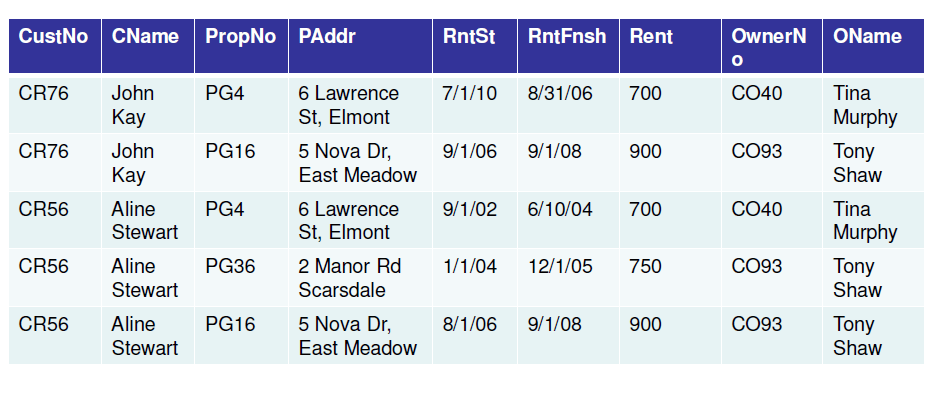
Original Table :

1NF

Making CustNo and PropNo as Primary Keys:

To make things easier , find functional dependencies , so it will make easier for us to break and understand the table :

We have three relations having the following functional dependencies:


– CustNo, PropNo -> RentStart, RentFinish
– CustNo -> CustName
– PropNo ->Paddress, Rent, OwnerName, Oname

As we see the functional dependencies , we can come up with the 2NF:

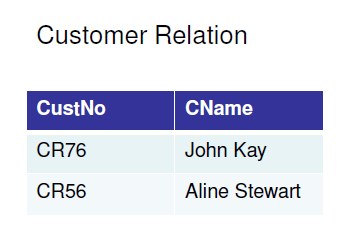
– Customer(CustNo, Cname)
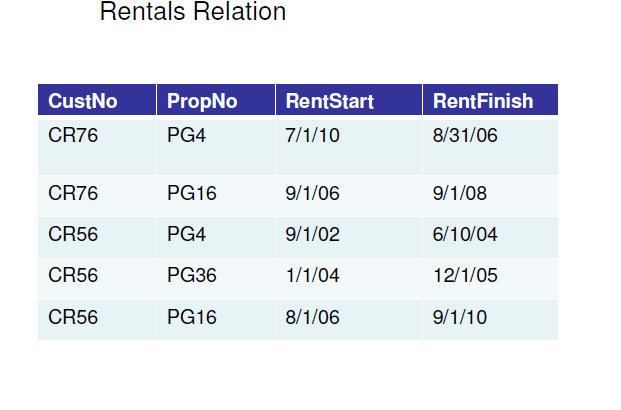
– Rental(CustNo, PropNo, RentStart, RentFinish)
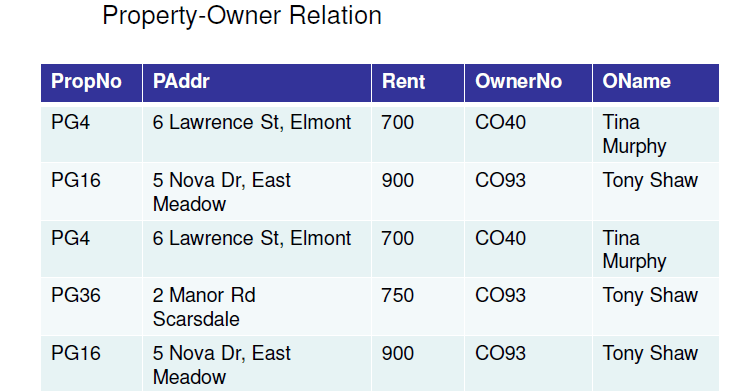
– Property_Owner(PropNo, Paddress, Rent, OwnerNo,OName).

2NF:

In 2NF, there the columns should not be dependent on partial or part of Primary Key.

3NF

No non-primary-key attributes that are transitively dependent on the primary key.

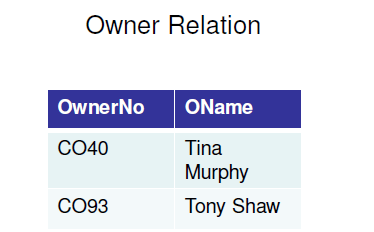
So, We have 4 relations:
• Customer(CustNo, Cname)
• Rental(CustNo, PropNo, RentStart,RentFinish)
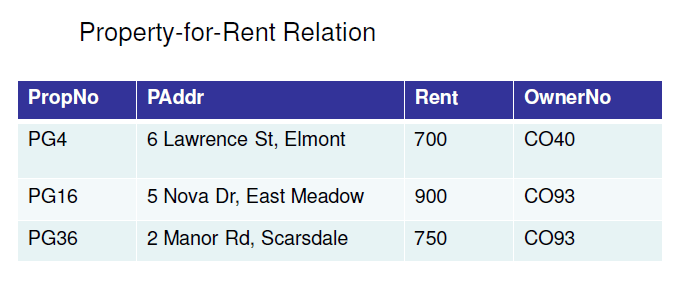
• Property_For_Rent(PropNo, Paddress, Rent, OwnerNo)
• Owner(OwnerNo, OName)

Update or insert of view or function ” failed because it contains a derived or constant field.

Many users encounter this issue while updating , inserting or deleting data from views .

Following is the link from MSDN which can clear the background while encountering the issue :

https://technet.microsoft.com/en-us/library/ms187956.aspx

Please read the updatable Views and Partitioned Views section in the above link .

For Instance : You will not be able to update the below View because a  View whose columns are a result of set operators like union , union all , intersect from other views or tables .

Create VIEW
[myview]
as
select a,b,c from X
union
select a,b,c from Y

Thanks

General overview of Truncate and Delete Statements in SQL

Truncate :

This statement removes all rows from the SQL table . The Truncate statement frees the space used by the truncated table . It does not create logs and adds additional space to memory.


Delete:

This statement removes specified rows as required by user in the WHERE clause from the SQL table . However, the Deleted needs to be Commit or Rollback in the SQL.The deleted data is stored in form of Logs ,so the deleted data can be reverted back to original state or in short ‘Undo’ the delete statement . Moreover , when logs are made , it creates additional space in the memory . So , we can say that Delete is costly statement when it comes to memory !


Thanks

Recent Google Maps API issue:This page didn’t load Google Maps correctly. See the JavaScript console for technical details.

I was recently working on a project in which I used the Google Maps API , I came across an error : This page didn’t load Google Maps correctly. See the JavaScript console for technical details . 

Resolution : 

I checked in the console tab in Developer tools in my internet Explorer , which threw the below error:

Google Maps API error: MissingKeyMapError https://developers.google.com/maps/documentation/javascript/error-messages#missing-key-map-error

So , I searched google support for this issue and found the solution on the below link:

https://developers.google.com/maps/documentation/javascript/get-api-key

Hit the Get A Key button and get your key to insert in your respective code , for example :

Key :  SyCj0as435MQBpLO5aLr9ArAurPARU   

Just add the key in the script calling the maps like this :

<script async defer src=”https://maps.googleapis.com/maps/api/js?key=SyCj0as435MQBpLO5aLr9ArAurPARU&callback=initialize”>


Thanks